


Blog
What is AI, Anyway?
While ChatGPT and other LLMs dominate the conversation, the real shift is moving past the hype to understand which specific AI tools - from simple rules to agentic systems - actually fit the problem you’re trying to solve.


Start typing and press enter to search



Moya is a Christchurch-based Senior Consultant. As well as being adept at process improvement and creatively analytical about AI, she's also your go-to for steampunk and fantasy-writing chats.
The history of innovation has generally been kind to us, but it’s always followed a familiar, slightly lopsided, rhythm. When the world was emptier and cleaner, we had the luxury of time. We could launch a new technology, watch it succeed or stumble, and observe a few pioneers build fortunes before the common benefits eventually reached the rest of us.
The catch?
It always took much longer to identify, accept, and legislate for the unexpected downsides.
Today, the tables have turned. Innovation is accelerating at a breakneck pace, but our ability to build comprehensive guardianship and international laws is struggling to keep up. While it’s notoriously difficult to regulate a product that doesn’t exist yet, the urgency has never been higher. Large Language Models (LLMs) and agentic AI are challenging our need for boundaries faster than any technology in history - and further innovation is coming hard on the heels of these giants.
To understand why AI feels different, we can look at the "time to benefit" for the giants that came before it.
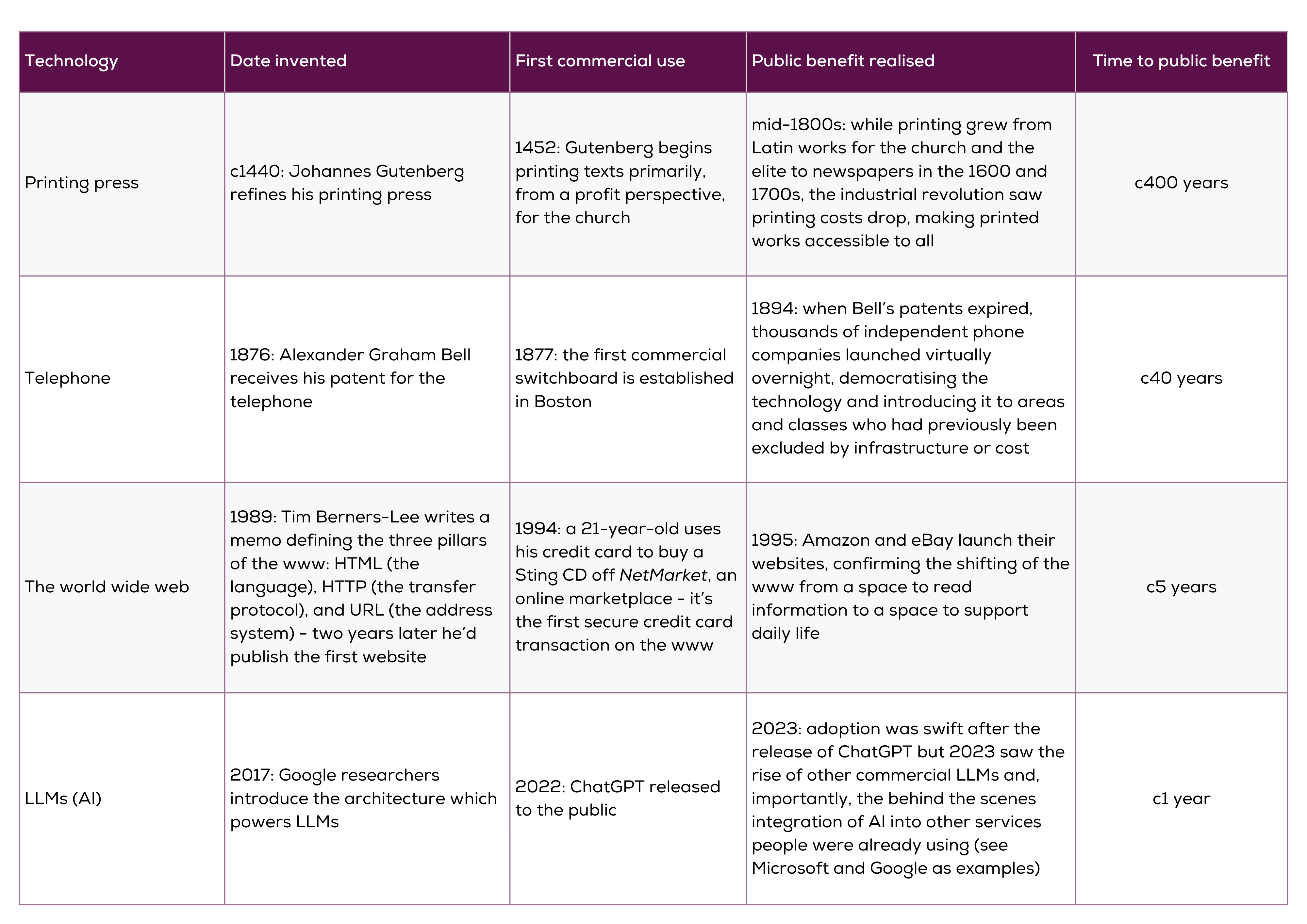
In the past, we had decades to adjust. With AI, we went from a research paper to 100 million users in just three months. This "leap" is instantaneous, but the guardianship is still ambling to the starting line.
Historically, wealth goes to the risk-takers and their backers first. In the eras of the printing press, rail, oil, and electricity, those early entrepreneurs were - to put it mildly - relatively unconcerned with worker safety or environmental impact. Controls were slow to arrive:
Risk-takers take risks. Unless the public demands it, sustainability is rarely a priority for those chasing high first-mover profits. But our world is more fragile now. We no longer have a century to wait for the “Clean AI Act” equivalent for large-scale data and AI.
In a crowded world where reducing CO2 emissions is non-negotiable, energy availability is variable, and potable water is becoming our most precious resource, LLMs and Big Data have made a massive grab for these very resources, often in fragile environments and impoverished communities.
While there are promises of improvement, there is currently little to hold the early movers to those promises. Ironically, these are the communities that might well benefit from the environmental monitoring applications that use large-scale AI.
The OECD has established updated AI Principles for 2025, focusing on inclusive growth, human rights, transparency, and accountability. These are vital benchmarks, but principles are only as good as the laws that enforce them.
New Zealand adheres to these OECD principles, but history suggests there is a struggle to move from "principles" into domestic law, especially in an unstable international landscape where our small nation is so often a price-taker for desired technology.
The MBIE July 2025 "Going for Growth" guidelines are unashamedly pro-innovation. The goal is to leverage AI for immediate national benefit and remove impediments to investment. As a short-term steward for the country, this approach is hard to fault. We need to stay relevant on the world stage.
However, there is a clear gap between our aspirations and our mandates:
As a small island nation, New Zealand walks a tightrope. We want to attract investors and protect our citizens while also respecting the environmental and human rights of people in less developed nations. We are doing an excellent job of attracting growth; now we have the opportunity to lead in sustainable management.
We have to ask: How can each of our AI projects move our thinking toward along-term, sustainable direction?
If we continue at the pace of the last century, we won't have the resources left to fix our mistakes.
We need to "get it sorted" in a lot less than a hundred years.

While ChatGPT and other LLMs dominate the conversation, the real shift is moving past the hype to understand which specific AI tools - from simple rules to agentic systems - actually fit the problem you’re trying to solve.
Link copied to clipboard


