


Start typing and press enter to search
Start typing and press enter to search



You’re in a meeting room that has suddenly fallen dead silent.
Right on cue, your stomach rumbles. Jane from finance glances over at you. Convinced everyone can hear, you make some awkward comment about not having lunch yet.
It’s 2:30PM and you haven’t stopped all day. Between back-to-back meetings, corridor conversations, and Teams’ messages, your day has vanished.
As BAs, we live in a world where time is a precious commodity. AI is adding to the pressure - there’s an expectation that things are just … quicker. You need to get a document out by the end of the day, so you revert to using Copilot and churn out a 15-page document at the click of a mouse button.
There’s a trap here, and it’s one that has always existed - even before AI. In the messy world of projects and business, creating documents or diagrams is often an easier demonstration of tangible progress than something more ambiguous like connecting dots, aligning stakeholders, or creating shared understanding. We’ve been trained to see value as ticking boxes. The easiest way to do that is to create an output.
An output does not automatically mean outcomes, however.
What is an outcome really?
Is it a tangible thing?
Sometimes perhaps, but often I’d argue it’s not.
An outcome is rarely an artefact. It’s shared clarity. It’s alignment. It’s a decision unblocked.
The simplest filter to separate outputs from outcomes is asking two blunt words: "So what?"
The problem with a ‘So what?’ attitude is when it’s used with an absence of judgement. When combined with critical thought, it becomes a powerful tool - a superpower, even - that we can apply to just about every decision we ever make.
‘So what?’ is about caring enough to use our valuable time where it matters the most.
When I think about ‘So what!?’, I think about two key things:
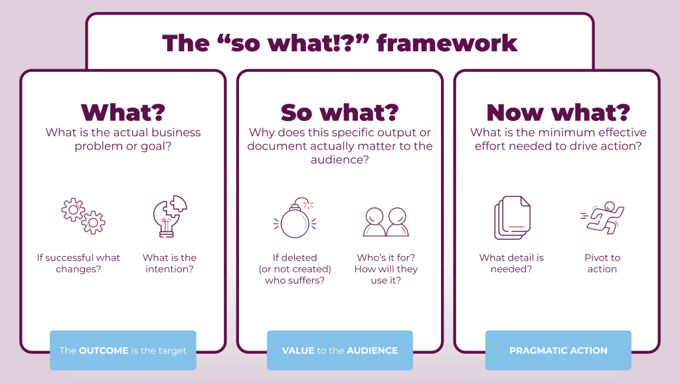
Once we’ve decided that there is value, that the thing is worth doing, there’s another trap. I call it the ‘Devil in the Detail’ trap - the fear that, by not getting down into the weeds, we’re going to miss something important. That fear means we often default to maximum detail.
This is where ‘Now what’ kicks in. This is where we decide how to execute.
We’re faced with trade-offs every step of the way. What elevates a great BA is their ability to apply judgement and balance across three key elements: Detail, Speed, and Quality. It’s not about getting to the deepest level of detail every time.
Think about these three elements and consider how to trade them off against each other:
The reality is:
When capacity is maxed out, every priority is a trade-off. We can't maximise everything. The question isn't “Can we do it all?” It’s “Where does our effort create real value right now?”
Being useful means matching your dial to the moment:
Delivering value isn't about how exhausted and hungry you are at 2:30PM, or how many pages your generative AI tool spat out before the end of the day.It’s about knowing what the situation actually demands - and having the courage to trade off speed, detail, and quality to meet it.
When did you last care enough to ask ‘So what?’
And, the next time you face a deadline, how will you decide whether to favour detail, speed, or quality?
Matt Duce is Redvespa's Head of Consulting.
This article is a companion piece to a previous article and serves to help you be, bloody useful.
Link copied to clipboard


