


Start typing and press enter to search
Start typing and press enter to search



Being "bloody useful" is the defining trait of a great business analyst.
I’ve worked with many Business Analysts across dozens of industries. If I had to distill what separates the good from the great into a single phrase, it would be this: the very best BAs are "bloody useful." In fact, I’d go as far as to say this should be the defining characteristic of almost any profession. A common complaint I hear about BAs is that we are "blockers". I’m incredibly proud to consider myself a BA and each time I hear that I feel a little part of me dies inside. While there may be valid reasons for this - misunderstanding of the role or hidden technical complexities - we must ensure we aren't getting in our own way.
I was talking to a client recently who was navigating an incredibly noisy and exhausting internal dynamic, sadly not an uncommon thing lately. Between a mountain of projects, a multitude of priorities and maintaining BAU, they were reaching a breaking point. As we were talking about what they needed, and where our consultant needed to be putting their efforts, I could see it in the client's eyes: every question I asked felt like another heavy decision added to a day already full of them.
In that moment, I realised they didn't need to get stuck in the weeds of "what something is or is not." They simply needed their load lightened.
My response,
“It sounds like you just need our consultant to be bloody useful.”
While we must be deliberate in our methodology, sometimes the most impactful thing you can do is be the person who removes a brick from the wall rather than adding one. Getting to that level of "instinctual usefulness" takes practice.
Here are three frameworks I use to ensure I’m adding value without adding noise.
Learn that no two scenarios are identical. A rule or guideline that served you well on your last project might be a hindrance on this one. The skill in pragmatism is knowing when, and how far, to push the boundaries.
If a colleague is having a difficult day and an issue arises they would normally resolve, sometimes just doing it yourself is the right course of action. Before you step in, ask yourself,
"Is my intervention helpful both right now and further down the line?"
If the shortcut creates a long-term risk, pause. If it simply solves a problem and reduces friction, just do it.
To be useful, you must have the self-awareness to navigate office politics. For a long time, people have used the Karpman Drama Triangle to illustrate the connection between personal responsibility and three roles often involved in conflict. It outlines these roles as:
As humans, we are all susceptible to these roles. Being "bloody useful" means recognising when you - or those around you - are slipping into these behaviors. The Drama Triangle describes reactive, anxiety-driven roles people default to under stress. While useful for recognising dysfunction, it also leaves you asking “what do I do instead?”
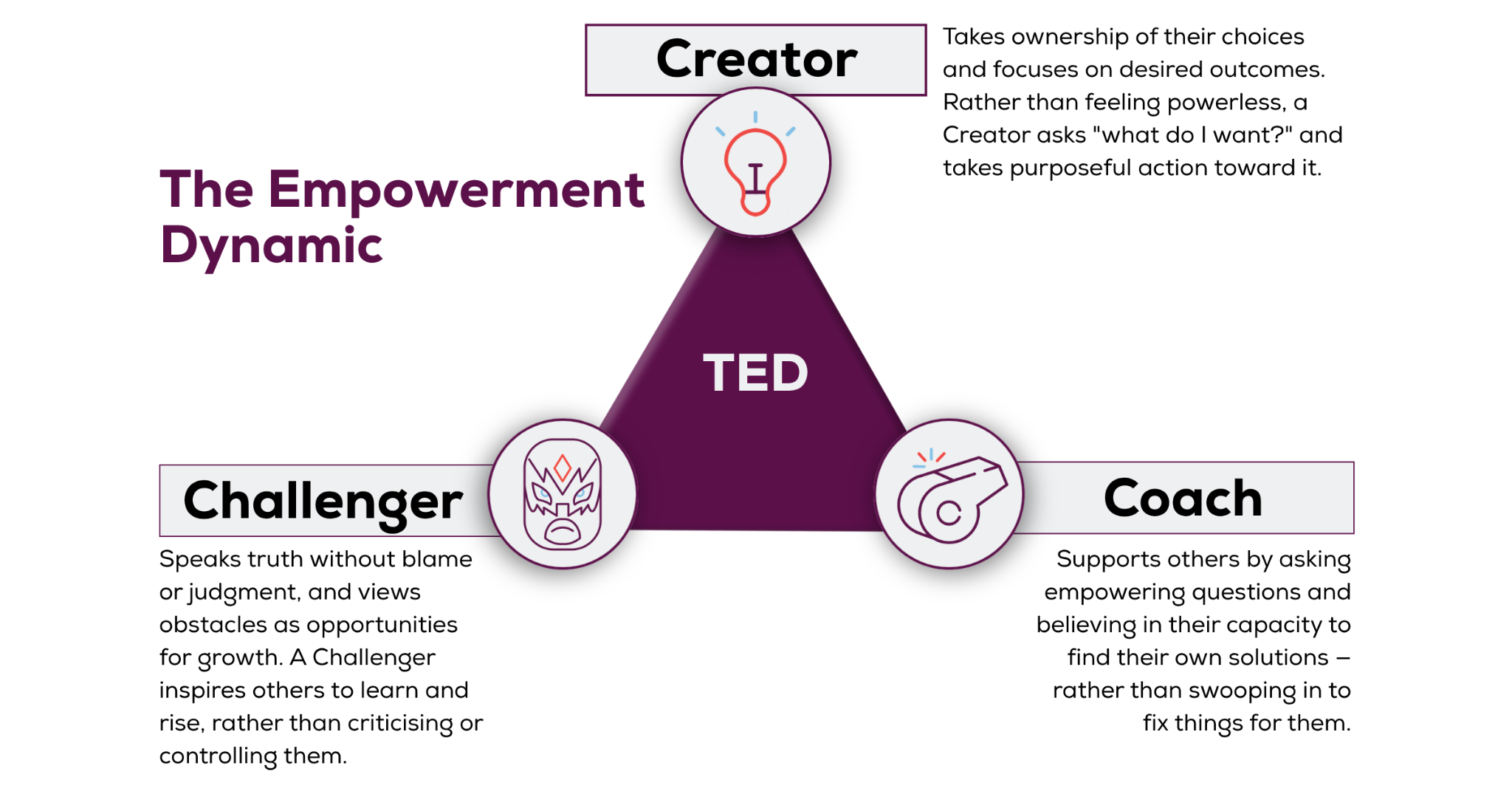
That’s where people have started to move towards The Empowerment Dynamic (TED) as something of an antidote. The Drama Triangle, while excellent at helping people recognise toxic patterns, offers no real path forward. TED fills that gap by being strengths-based, outcome-focused, and grounded in the belief that people are fundamentally capable; giving individuals concrete roles to step into rather than just patterns to step away from.
Adapted from the book Nudge by Richard H. Thaler and Cass R. Sunstein, the EAST framework is a brilliant way to ensure your outputs are well-received and actionable:
There are countless techniques and skills yet to be discovered, but the core of the role remains the same. If you can navigate the fine line between right and wrong (a definition you won't find in your job description), avoid adding to the noise, and deliver pacey, high-quality outcomes, you are well on your way.
What do you do in your role to be truly useful?
Matt Duce is Redvespa's Head of Consulting.
Consensus within Redvespa is that he is, in fact, bloody useful.
Link copied to clipboard


