


Start typing and press enter to search
Start typing and press enter to search



Tap-tap-tap. Tap-tap-tap.
In 1990, Stanford researcher Elizabeth Newton ran an experiment with this setup: people tapping out the rhythm of well-known songs on a table while a listener tried to guess the tune. Before the listener answered, she asked the tappers to predict how often they'd be identified correctly.
Tappers guessed 50%.
The real number was about 2.5%: three correct guesses out of 120 songs.
The tapper can't help hearing the full melody as they tap.
To the listener, it's just a series of disconnected knocks.
That frustrating gap, between the loud, obvious melody in one person's head and the confusing silence in everyone else's, happens across projects and in meeting rooms every day.
You know the scene: You've spent weeks in the detail. Mapping the process, working through the data, getting the plan tight. You walk into the update meeting confident in your work but, when you deliver your update, after all the effort you’ve gone to, the room gives you a blank stare.
That tapper/listener gap, between what you can't help knowing and what the other person is actually receiving, is what’s present in your update meeting. You hand people the same detail you've been tapping out for weeks, and they just don't know how to take it in.
This is the Curse of Knowledge: once we know something, it’s very hard to imagine what it's like not to know it. It’s harder still to convey it to others in a way they'll ‘get’.
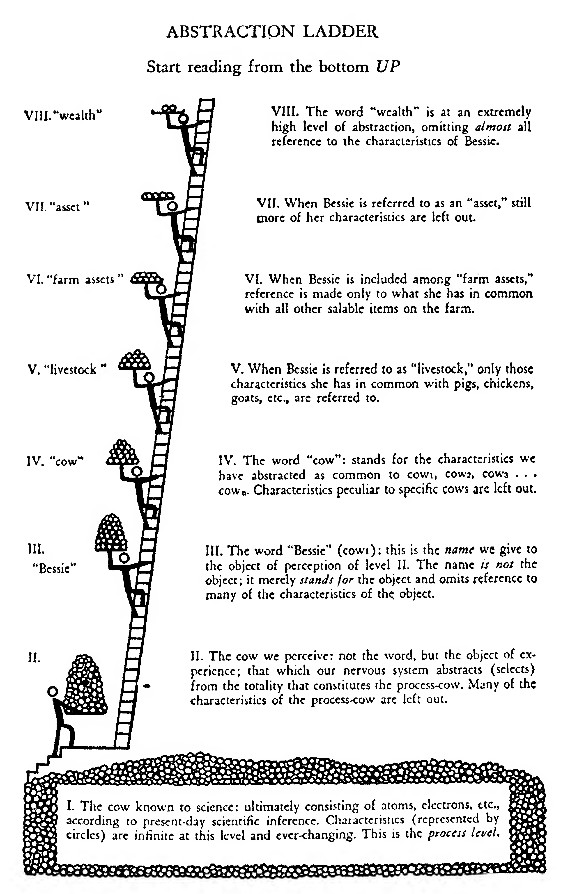
I’ve got a fix for this, and it's based on a concept which is coming up on 90 years old.
In 1939, linguist Samuel Hayakawa published Language in Action, introducing a concept he called the Ladder of Abstraction. It’s a model for describing how language moves between the concrete and the abstract.
To explain it, Hayakawa originally used a cow named Bessie. At the very bottom of the ladder, you have the concrete: the specific atoms and molecules making up the animal. Moving up, you move through to "Bessie" as a singular animal. Step up again, and it becomes "a cow," then "livestock." At the very top rung, Bessie becomes "wealth" or "an agricultural asset." As you climb, you lose specifics but gain broader meaning.
Movement up and down the ladder isn't confined to bovines. Fiction writing also uses the ladder to draw you into the story. A description of a man's eyes as blue, like the deep end of a swimming pool, is concrete. Push that same colour up a rung and it can describe a whole landscape, pockets of green and brown bleeding out to a hazy horizon that could exist anywhere in the world. At this point the colour stops being information and starts carrying mood.
In business, the Ladder of Abstraction is a visual tool that can help you meet people where they are. It’s not so different to how you might view explaining your job differently to a five-year-old than to a colleague. A five-year-old needs specifics, details they can comprehend. Your colleague does too, but their frame of reference is broader and it enables them to handle ambiguity and abstraction better.
When you take the Ladder and apply it to a project update, the key thing is you don't need as many rungs as Hayakawa did with Bessie to make it work. Three will do the job.
Bottom rung (the How)
Functional requirements, specifications, and raw data. Precise, tangible, literal. This is where the developers and the people building the thing live.
Middle rung (the What)
User requirements, workflows, and functional design. This translates the technical into something an end user doing the work can act on.
Top rung (the Why)
Strategic value and outcomes. This is where decisions about whether to fund, continue, or change course get made.
Most presentations fall apart because of misaligning perspective rather than misaligning content. Hayakawa called this dead-level abstracting: when a speaker gets stuck communicating exclusively on one level, on a single rung.
Put a sponsor at the bottom of the ladder and you’ll get a blank stare from the opening paragraph. Put a specialist at the top of the ladder and they are left guessing the actual mechanics of the build. To overcome the curse of knowledge, don't assume everyone is on the same rung, and don't assume everyone cares about every rung.
You need to be able to climb up and down the ladder while considering your audience at each rung.
When you're stuck describing technical work, use the "So What?" filter as you step up the ladder, leading you to land somewhere your audience cares about.
Bottom rung:
"We're switching the form to a new template."
Middle rung:
"This removes the manual step where someone re-keys the same details into three different systems."
Top rung:
"It cuts the risk of the errors that used to mean a week of rework every time someone missed a field."
Each step answers the question the previous one raised.
The same climb works in reverse. Strategic language like "digital transformation" or "cross-functional synergy" means nothing to the person who has to live with the change day to day.
Give them something they can picture. When handed a top-rung abstraction, force it down the ladder by asking, "How does that work when it’s invoicing day?"
Instead of "a 10% improvement in operational efficiency," try: "you get two hours back every morning that used to go into re-entering the same data." One of these a person can imagine doing. The other isn't a sentence anyone has ever said out loud in a real conversation.
Information on its own doesn't move a decision. The most persuasive updates keep moving between rungs rather than settling on one: the big goal explains why the details matter, and the details prove the goal is more than a slogan.
Before your next update, look at what you've prepared and ask which rung you're on, and whether it's the one your audience needs from you.
Oh, and the taps at the top?
Tay Tay.
"Shake It Off."
Jamie is Redvespa's Head of Experience, and an avid Swifty.
Link copied to clipboard


